What's a Microsoft Certified Professional Worth?
Your MCP has value, but how much? A look the salary picture for Microsoft Certified Professionals now, and what to expect in the next 12 months.
Your MCP has value, but how much? A look the salary picture for Microsoft Certified Professionals now, and what to expect in the next 12 months
We're baaaccckkkk! Yes, it's the return of the MCPmag.com Salary Survey, the sibling survey to the one we run on Redmondmag, only more certifiable. That is, we take a different tack on this survey, providing you with a look at IT compensation that's decidedly MCP-ish.
This survey might seem familiar if you've been reading MCPmag in the last decade or so, but there is a difference that we'd like to explain at the outset. In past years, we offered comparisons to prior years' results. We really can't do that this time out, since the last time we surveyed our certified readership exclusively was back in 2005, when an MCP was an MCP and having an MCSE meant you were elite among the IT cognoscenti (but not among real engineers, of course, but that issue is now moot). In 2006, we performed a joint version of the survey for Redmond and MCPmag, wherein the methodology was reconfigured significantly.
And there is another significant difference: When we ran this survey last, we had a fairly small number of MCP titles to consider. Since then, Microsoft has revamped the new-generation certifications significantly and that means dozens more titles, and more ways to slice and dice data.
With that, consider this version 7.0 of the survey. It's new-generation and more of what matters to you.
So, let's get to those numbers, shall we?
Not Your Average IT Admin
Some basic findings from this year's results show that IT admins who still have a job make better than $80K on average. Respondents said their salaries increased by better than $2K over the previous year, a year that is feeling more like the end of the recession years. Even better: they also claimed to have nearly exceeded $3K in bonus money.
A few other noteworthy results from this year's survey.
- Respondents are well-tenured, with average age being what might be endearingly called "middle-aged."
- Most respondents are going into the second decade into their IT careers.
- We're seeing more women in the IT ranks, with the gap in the ratio getting narrower than in salary surveys we've conducted in years past.
We explore some of the finding you see in the chart on this page later on in this survey. Next up: What compensation looks like based on job titles.
Salary by Job Title
As we've seen in year's past (and as indicated by the chart here), management and programming project leads are often well compensated above any others. They're the figureheads for IT teams, accepting praise for successes on the teams' behalf or having to explain failures. Network project leads also often do well, but in the scheme of things, it's the DBAs and database developers who came in right above on the salary scale. DBAs and developers often tell us that they're well compensated and happy with their pay, and this year is no different. It's data, after all, that is at the heart of many businesses and good data people are often plied with incentives to either stay put or lured away to companies who can afford to pay higher salaries.
Job titles have an effect on salaries, but so does the technology you've got expertise in. That's next.
Pick Your Expertise
We asked readers to tell us their area of technical expertise, and from that we gleaned their salaries. The top three are highly specialized ones:
- Extranets ($94,065)
- Oracle ($93,956)
- Data warehousing (at $92,822, it edged out software design)
There are some areas of expertise that are just hot right now, and we'll likely see an uptick in the average salaries for those who possess such skills. Virtualization has been hot and it's likely to remain red-hot for the months to come. It's just slightly above the average salary of all respondents, and it's likely to keep or exceed that pace as more companies realize the cost benefits.
And we expect that even though wireless/mobile computing ranked fairly low salary-wise this year, compensation might come in higher in next year's results. That's because mobile app development is hot right now, due to the proliferation of Windows Phone and Google Android devices in the enterprise. That bodes well for app developers in the next 12 months -- as apps developers are moved over to programming for devices, there'll be a need for your generalist app developers.
Now that you know what technologies are in demand from a salary perspective, what Microsoft products pay the best? Take a guess before heading to the next page, because we're sure you'll be surprised.
Showing Off Your Microsoft Skills
For the next chart, we asked respondents to tell us what Microsoft technologies they could claim expertise in, and they were allowed to choose as many as applied to them.
Those who said they have Project Server expertise claimed the highest compensation in this year's survey. We notice that those who did were rare, but there were enough Project Server experts to make it count. Browsing the results more closely, we also noticed that most of them had managerial or C-level titles.
Other hot areas include Application Center, Systems Center and BizTalk Server. We expect that more people next year will claim SharePoint and Hyper-V expertise, and we'll predict now that those salary figures will slightly dip next year because of that.
At the low end are technologies that are at end-of-life support, such as Windows XP ($67,587), the ambiguously-named and catchall expertise Windows client support ($68,199) and Small Business Server ($70,667).
Next up: The reason you read this survey in the first place -- salaries by Microsoft certifications.
Salary by Microsoft Certification
One thing sticks out like a sore thumb on this chart: Those who claim the MCTS: BizTalk 2006 title command the highest salary, even over those owning any Professional-level title (but in some cases, and not by much). The high salary among those who specialize is something we've found every year to be the norm. Thus, the top three here:
- MCTS: BizTalk 2006 ($114,312)
- MCITP: BI Developer ($112,416)
- MCPD ($111,187)
Developers are often highly compensated, but we've found that many developers among our readership haven't achieved the highest level of certification (see chart below). SharePoint topics seem to be hot with our readers, and the same goes for salaries based on that certification. Developer and database titles have always done well on our surveys and this year's results show the trend continuing.
We'd like to point out that Microsoft Certified Master and Microsoft Certified Architect titles don't show up in our results, and for good reason: We're still not getting enough data back from respondents who have those titles.
Now, at the low end is what you might expect:
- MCDST ($72,819)
- MCITP: Enterprise Support Technician ($77,685)
- MCP, any ($78,048)
So, Who Holds What?
To put the salaries in the above chart into perspective, the next chart shows the certifications held by readers. Because the old-generation certifications don't retire, we continue to look at them, and outside of the MCP a significant portion of readers still claim the older MCSE titles.
With the new-generation certifications, respondents said their paths have led them to where the demand is: mainly Windows OS and anything denoting advanced IT administration. Specialists are rare, but that rareness also translates to higher salaries, as well see in later charts.
Our developer readership is slim, but we heard from enough of them that we got some solid compensation figures for the related certification figures. (Expect more significant data to come from Redmond Developer News' upcoming Salary Survey later this year.)
As is the case with the chart above, we have yet to get any significant data on Microsoft Certified Master and Microsoft Certified Architect titles, so we excluded them in this chart as well.
Microsoft certifications aren't the only certification game in town. Respondents tell us they've also found value in other technical certifications they've obtained. You'll find the salary results based on those non-Microsoft titles on the next page.
You Must Be Certifiable
Our readers usually don't stop at just being Microsoft certified and will often use certification as a gauge for their understanding of technology. Some of our readers said they actually started their certification journey through other programs, such as the CompTIA or Cisco programs before taking on a Microsoft certification.
The majority of respondents this month were asked to choose all the certifications they held this year. With that, we extracted compensation figures for those who own other certifications beyond those in the Microsoft program. Hot areas include Cisco, Oracle and IBM.
A large number of MCPmag readers own one of the many current and live Cisco certifications that we'd be able to produce a separate survey of Cisco title holders (but we'll save that idea for another time).
How about we move on? Next, we look at some of the reasons readers get certified.
Cause and Effect
As has been the case in salary surveys of years past, we always ask about the effect one's Microsoft certification has on salary. Most respondents, it appears, don't really seem to think much about the money, but are more interested in how certification and training can help to improve one's IT knowledge. And this chart seems to bear it out, as most respondents (54 percent) see no change or are absolutely unaware or haven't seen any directly effect that certification played in any salary increase.
What's the most interesting thing to come from this chart is that respondents have pretty much one big reason for achieving certification these days. An overwhelming number, 71 percent, said it was a personal goal, while 48 percent said certification would help them distinguish their skills from others. Thirty-two percent said it worked as leverage to get a better job. It's reason like these that tell us that certification does make a difference, even though it may not always be monetary.
Next: The bonus picture.
Bonus Time
Even though things began looking up last year, it was still considered a recession year. And that meant that companies' coffers were shut down pretty tight. As you can see in this series of charts, most respondents (52%) said they received no bonus. Of those who did, though, most were in the $1,00 to $5,000 range. Interestingly, 5 percent saw $15,000 or more. Company profitability is a big factor, but so is personal performance. Here, certification doesn't seem to have much impact.
As for additional compensation, 401(k) contributions and paid medical and dental are mainstays, as companies also were less inclined to offer profit-sharing and stock options.
Up next: Salaries by range, just for the curious.
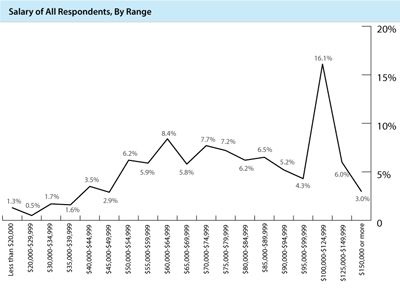
Compensation Breakdown
Besides asking respondents to give us an exact salary figure, as a gut check we also ask respondents to tell us their salary based on a range. Looking at the salaries by range can give us a good idea where one's salary compares to others in the grand scheme of things. In this chart, more than a quarter of respondents reported making more than six figures. Below that line, the next biggest slice comes from those in the first $60K, which is where we find mainly those whose work is predominantly systems administration or help desk support. And salaries by range mainly go up from there.
[Click on image for larger view.] |
On the next page, we ask a question that has some bearing on salaries: hiring.
The Hiring Picture
As we do every year, we also ask whether respondents are privy to hiring practices at their companies, and if some companies are expected to hire in the next 12 months. Thirty-five percent of all respondents believe their companies, a significant figure, to be sure. Of those who said that hiring would take place, 44 percent believe one to five people will be hired, and a third of all respondents believe Microsoft certification to play a role in hiring.
Finally, we asked what kind of impact Microsoft certification has on one's career. An overwhelming 70 percent said it has had a positive effect.
And that's what compensation for 2011 looks like. We know that you've looked to us to provide a gauge of the state of Microsoft IT – our Redmond Magazine survey is still the most popular article we run online. So, it only makes sense that we continue the certification portion, so that you can continue to look to us to put a quantifiable measure on your careers as well as your certifications.
We hope the results you find here will help in that regard, particularly when it comes time to justify your value to the company or to the next company to hire you.
I'd love to hear your thoughts on the data we presented here. You can write to me at [email protected].